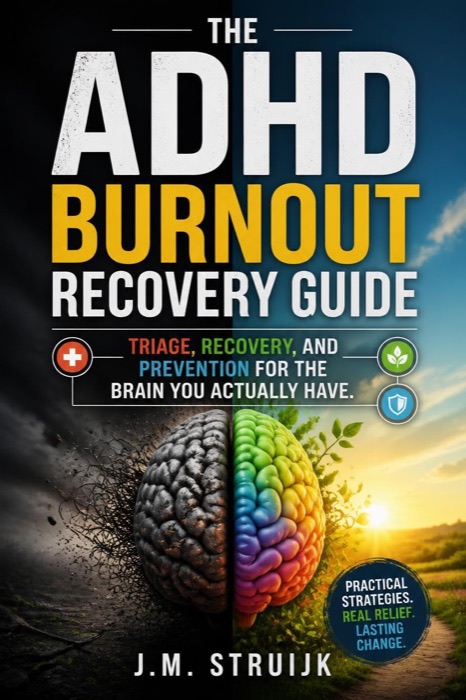
Standard burnout advice is rest, boundaries and self-care. It assumes a brain with steady energy and reliable executive function, which ADHD brains do not have. That is why the advice keeps failing.
This book treats ADHD burnout as a high-cost system that broke from running too long without enough maintenance, and gives you protocols built for that.
Who it's for
- You have been called lazy or told you were not applying yourself for as long as you can remember.
- You have crashed, recovered, and crashed again, and you are tired of the cycle.
- Standard burnout advice reads as though it was written for someone else.
- You want something specific and honest about how your brain works.
What's inside
- A five-minute triage you can do in bed when you are already crashing.
- Yellow, orange and red burnout zones, and what to do at each level.
- Recovery protocols for the three things that fail in every ADHD burnout: motivation, executive function and masking.
- The four patterns that produce ADHD burnout: overcommitment, perfectionism, understimulation and hyperfocus crashes, with ways to interrupt each.
- Energy management in place of time management.
- Prevention systems that keep working once willpower runs out.
The book is laid out for how you will actually arrive at it. If you are crashing right now, Chapter 4 has the five-minute triage. If you are noticing warning signs, start at Chapter 2. If you have recovered once and are crashing again, the middle of the book covers the patterns behind the cycle.
Where it fits
This is a standalone book. If you are AuDHD, The Late-Diagnosed Autistic Workbook covers autistic burnout alongside masking. The article on autistic burnout, ADHD burnout and depression explains how to tell them apart, and hyperfocus without the crash covers one of the four patterns.
Common questions
Where should I start if I am burnt out right now?
Chapter 4, which is a five-minute triage designed to be done in bed. The rest can wait until you have some capacity back.
Is ADHD burnout the same as depression?
No, although they can overlap and occur together. If you have persistent low mood, have lost interest in things you used to enjoy, or are having thoughts of harming yourself, please speak to a doctor. This book is not a substitute for that.
Does it cover masking?
Yes. Masking is one of the three failures the recovery protocols address, along with motivation and executive function.